Mac Os Generate Rsa Ssh Key
- This will step you through the process of generating a SSH keypair on Mac OS X. Begin by opening your Terminal, generally found in the 'Utilities' subdirectory of your 'Applications' directory. Generating a keypair. Before you generate your keypair, come up with a passphrase. The rules for good passwords also apply here: mix of upper and lower case, numbers, spaces and punctuation.
- Then proceed to your Git repo. Manage Account (With the assumption you are on bitbucket client) Click on SSH Keys and then Add Key. Open the idrsa.pub file created in step 2: copy the contents in above mentioned file and paste the contents in the text box on bitbucket.
This tutorial will show you how to generate and secure SSH keys on macOS Sierra (10.12) and macOS High Sierra (10.13). SSH keys allow you to log into your server without a password. They increase convenience as well as security by being significantly more resistant to brute-force attacks.
This will create a RSA public/private key pair in the.ssh directory below your account’s home directory. For example: Location: /.ssh (where is the home directory) Private key file name: idrsa. Public key file name: idrsa.pub. Cd /.ssh # Change directories to the keys location. Ls -l # Verify the keys are available. To generate SSH keys in Mac OS X, follow these steps: Enter the following command in the Terminal window: ssh-keygen -t rsa -b 4096 This starts. Press the ENTER key to accept the default location. Type in a passphrase. You can also hit the ENTER key to accept the default (no passphrase). The standard OpenSSH suite of tools contains the ssh-keygen utility, which is used to generate key pairs. Run it on your local computer to generate a 2048-bit RSA key pair, which is fine for most uses. Ssh-keygen The utility prompts you to select a location for the keys. May 27, 2010 Linux Generate RSA SSH Keys. Tagged as: Tags Linux, Mac OS X, open terminal, operating systems, remote server, ssh-keygen command, UNIX. Generating a new SSH key and adding it to the ssh-agent After you've checked for existing SSH keys, you can generate a new SSH key to use for authentication, then add it to the ssh-agent. Mac Windows Linux All.
SSH (Secure Shell) is a protocol most often used for remote management and for file transfer often denoted as sFTP (Secure File Transfer Protocol). When accessing a remote server such as a Vultr VPS, it is recommended to use SSH with PKE (Public Key Exchange) which uses a key-pair where the public key is provided to the server and the private key in stored on your machine.
SSH Keys can be automatically added to servers during the installation process by adding your public keys in the Vultr control panel. You can manage your SSH keys on this page. It is important to remember that these are your public keys only (usually denoted with .pub), you should never expose your private keys.
Key types
There are several different key types that can be selected. Use the -t argument upon generation, such as ssh-keygen -t ed25519. The ED25519 key type, which uses an elliptic-curve signature, is more secure and more performant than DSA or ECDSA. Most modern SSH software (such as OpenSSH since version 6.5) supports the ED25519 key type, but you may still find software that is incompatible, thus the default key type is still RSA.
The default key type is 2048-bit RSA which offers good security and compatibility. For higher security, you can choose a larger key size using the -b argument on generation, such as ssh-keygen -b 4096 to create a 4096-bit RSA key pair.
Key generation
To generate an SSH key, you will need to open Terminal.app found in 'Applications > Utilities > Terminal'.
To create a 4096-bit RSA key pair, enter:
Then you will see:
Pressing Enter/Return will save your new key pair to this default location, which is recommended. You will then have the option to create a passphrase, which will encrypt the key so that it cannot be used without authorization. Using a passphrase is also recommended.
At this point, your keypair has been created and stored in ~/.ssh/id_rsa. To make the key available to the system and store the passphrase in the system keychain, we will need to complete several additional steps. Note that this is only needed if you would rather not be prompted for the key passphrase each time it is used.
Add new keypair to SSH agent
Enter ssh-add -K ~/.ssh/id_rsa. You will then be prompted for the passphrase and you will see the following:
If you would like to use this SSH key to log into a server that has already been created, you can use the ssh-copy-id tool to store the public key on the server you would like to access.
Add new key to remote server
Using ssh-copy-id:
The console will request your login password since the remote server is not yet aware of your key. You will see the following:
You can now attempt to log into the remote server with ssh root@192.0.2.1 and you should be connected without a password prompt.
Last updated 29 February 2012.
This will step you through the process of generating a SSH keypair on Mac OS X. Begin by opening your Terminal, generally found in the 'Utilities' subdirectory of your 'Applications' directory.
Generating a keypair
Before you generate your keypair, come up with a passphrase. The rules for good passwords also apply here: mix of upper and lower case, numbers, spaces and punctuation. Limit it to less than 31 characters.
Now, generate your keypair! Enter the following:
$ ssh-keygen -t rsa -C 'yourname@yourdomain.ext'
Note: Do not type the dollar sign above; it is an example of the default command prompt shown by Mac OS X. Your actual prompt may be different. In the example above and below, the actual part you should type is the part that follows the dollar sign.
Generate Ssh Key Windows
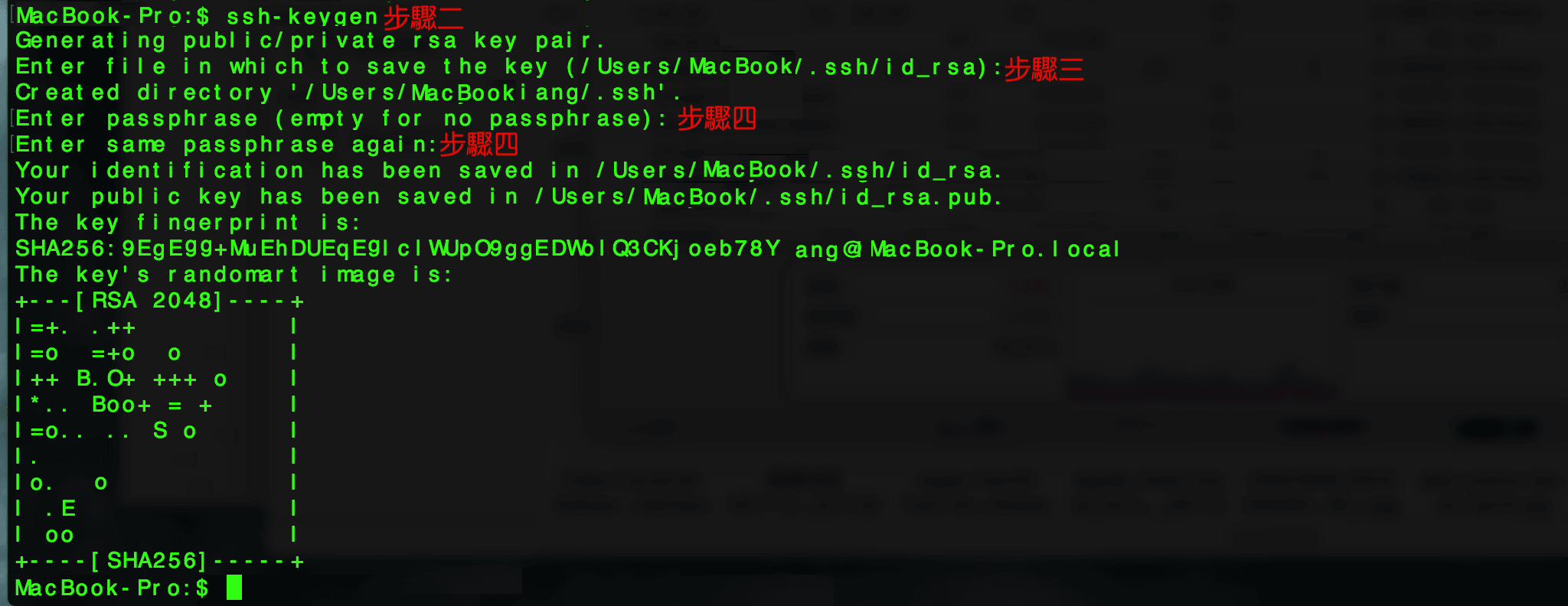
Your terminal should respond:
Press Return to accept the default value. Your terminal should respond:
Enter passphrase (empty for no passphrase):
Enter the passphrase you decided on above. The response will be:
Enter same passphrase again:
Enter the passphrase again and press Return. The program will think a bit, and respond with something like this. Note that many of the details in the example below are just for example purposes; much of the actual output you see will differ from the below.
How do I copy my public key into my Mac's clipboard?
You can use the pbcopy utility to easily insert your public key (or other text files) into your Mac's clipboard so that you can add it to your Drupal.org profile, GitHub, or other places. The filename should be yourfilename.pub - with yourfilename being the filename you entered when you first created this file. If you just hit enter, the default is id_rsa.pub.
$ pbcopy < ~/.ssh/id_rsa.pub
You won't see any output in the terminal, but the contents of your public key will now be in your clipboard and can be easily pasted anywhere where you can normally paste text.
In case you're curious, the pbpaste utility works the other way, allowing you to easily grab the contents of the clipboard for use in the terminal. For example, the following command will write the contents of the clipboard to a file:
Mac Os Generate Rsa Ssh Key Password
$ pbpaste > ~/clipboard.text