Dynamodb Write Auto Generate Key Javascript
Apr 15, 2020 AppSync lets us perform DynamoDB operations (GetItem, PutItem, UpdateItem etc.) without having to write any custom Lambda functions. For example, to perform PutItem against a DynamoDB table, we need a request template like this. I know the theory. I studied and watched numerous courses for C, Java, Python, javascript, HTML, CSS, Angular. I can look at code someone else wrote and understand it. I can only write things if I'm following a step-by-step guide. Ask me to do something by myself, and I can't write code to save my life. I don't even know where do I begin. Nov 20, 2017 Another approach is to use a UUID generator for primary keys, as these are highly unlikely to clash. IMO you are more likely to experience errors consolidating primary key counters across highly available DynamoDB tables than from clashes in generated UUIDs. For example, in Node: npm install uuid.
- DynamoDB Tutorial
- DynamoDB Useful Resources
- Selected Reading

Creating an item in DynamoDB consists primarily of item and attribute specification, and the option of specifying conditions. Each item exists as a set of attributes, with each attribute named and assigned a value of a certain type.
Value types include scalar, document, or set. Items carry a 400KB size limit, with the possibility of any amount of attributes capable of fitting within that limit. Name and value sizes (binary and UTF-8 lengths) determine item size. Using short attribute names aids in minimizing item size.
Note − You must specify all primary key attributes, with primary keys only requiring the partition key; and composite keys requiring both the partition and sort key.
Also, remember tables possess no predefined schema. You can store dramatically different datasets in one table.
Use the GUI console, Java, or another tool to perform this task.
How to Create an Item Using the GUI Console?
Navigate to the console. In the navigation pane on the left side, select Tables. Choose the table name for use as the destination, and then select the Items tab as shown in the following screenshot.
Select Create Item. The Create Item screen provides an interface for entering the required attribute values. Any secondary indices must also be entered.
If you require more attributes, select the action menu on the left of the Message. Then select Append, and the desired data type.
After entering all essential information, select Save to add the item.
How to Use Java in Item Creation?
Using Java in item creation operations consists of creating a DynamoDB class instance, Table class instance, Item class instance, and specifying the primary key and attributes of the item you will create. Then add your new item with the putItem method.
Example
You can also look at the following larger example.
Dynamodb Write Auto Generate Key Javascript Login
Note − The following sample may assume a previously created data source. Before attempting to execute, acquire supporting libraries and create necessary data sources (tables with required characteristics, or other referenced sources).
The following sample also uses Eclipse IDE, an AWS credentials file, and the AWS Toolkit within an Eclipse AWS Java Project.
Q: What kind of query functionality does DynamoDB support?
Dynamodb Write Auto Generate Key Javascript Download
DynamoDB supports GET/PUT operations by using a user-defined primary key. The primary key is the only required attribute for items in a table. You specify the primary key when you create a table, and it uniquely identifies each item. DynamoDB also provides flexible querying by letting you query on nonprimary key attributes using global secondary indexes and local secondary indexes.
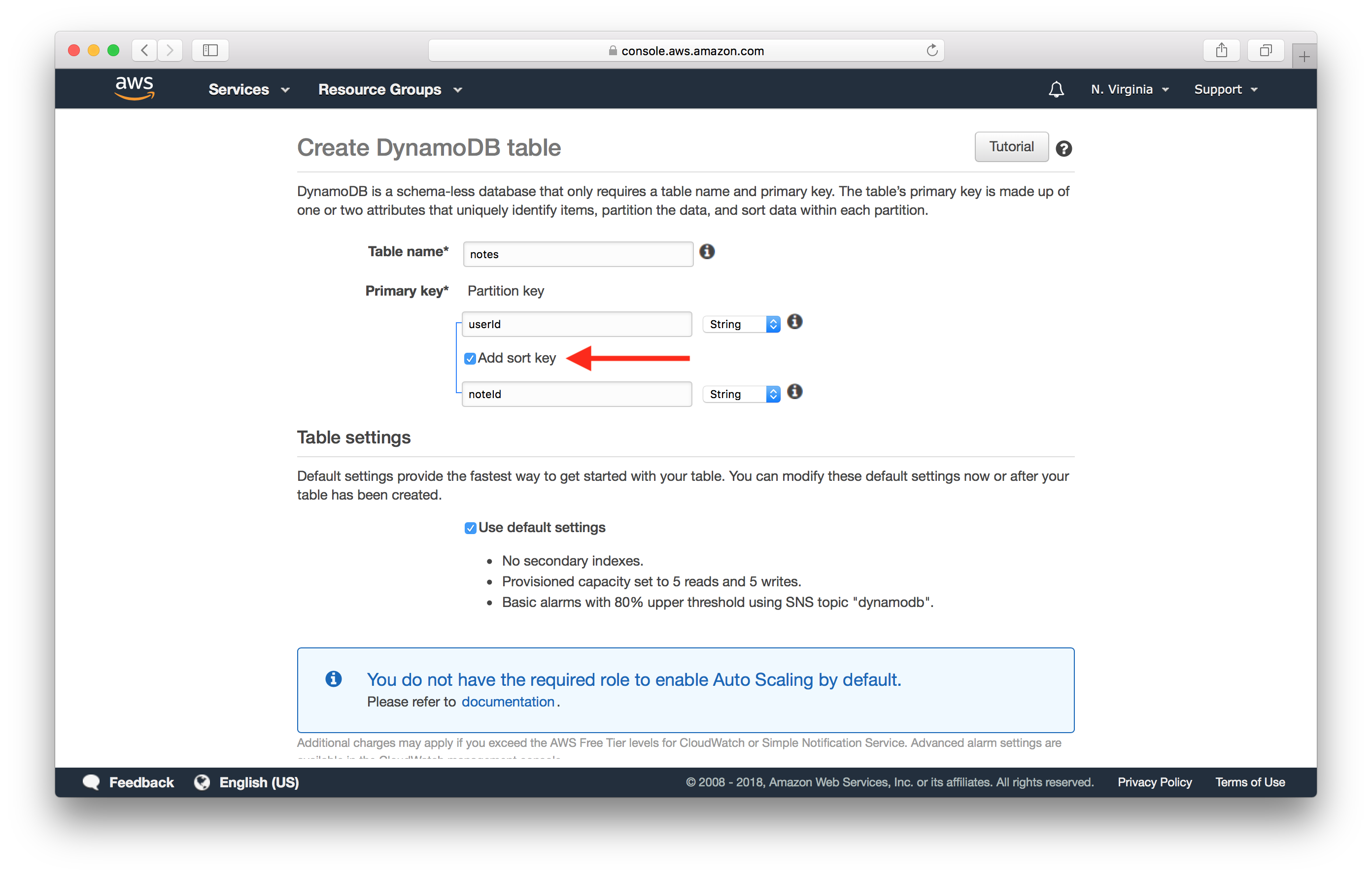
A primary key can be either a single-attribute partition key or a composite partition-sort key. A single-attribute partition key could be, for example, UserID. Such a single attribute partition key would allow you to quickly read and write data for an item associated with a given user ID. Rocket league ps4 key generator.
Dynamodb Write Auto Generate Key Javascript Download
DynamoDB indexes a composite partition-sort key as a partition key element and a sort key element. This multipart key maintains a hierarchy between the first and second element values. For example, a composite partition-sort key could be a combination of UserID (partition) and Timestamp (sort). Holding the partition key element constant, you can search across the sort key element to retrieve items. Such searching would allow you to use the Query API to, for example, retrieve all items for a single UserID across a range of time stamps.